What Agile Actually Means in 2025
Agile has been the dominant software development philosophy for over two decades — yet most teams that call themselves "Agile" are still shipping slow, drowning in process, and struggling to respond to change. The word has been stretched to cover everything from sticky notes on a whiteboard to enterprise SAFe implementations with 200-page transformation playbooks.
This guide cuts through the noise. We'll cover what Agile actually means in a modern product team, which frameworks work for which contexts, and the practices that separate high-velocity teams from teams that just hold more meetings.
The Agile Manifesto: What Still Holds Up
The 2001 Agile Manifesto established four core values:
- Individuals and interactions over processes and tools
- Working software over comprehensive documentation
- Customer collaboration over contract negotiation
- Responding to change over following a plan
These values haven't aged. What has changed is how we implement them at scale — across distributed teams, AI-assisted development, and increasingly complex product ecosystems. The twelve Agile principles remain the best filter for evaluating whether a process change actually serves the product or just serves the process.
Agile Frameworks: Scrum, Kanban, and When to Use Each
Scrum
Scrum is the most widely adopted Agile framework. It structures work into time-boxed iterations (sprints) of 1–4 weeks, with defined roles (Product Owner, Scrum Master, Development Team) and ceremonies (planning, daily standups, review, retrospective).
Scrum works best when:
- The team is building a product with a backlog of discrete features
- Stakeholders need predictable delivery windows for planning
- The team is co-located or has strong async culture
- The work can be broken into sprint-sized chunks
Where Scrum breaks down:
- Support/ops work with unpredictable interrupts — sprint commitments become fiction
- Research-heavy discovery phases — forcing unknowns into sprint stories creates false certainty
- Very small teams (1–2 engineers) — the overhead of ceremonies outweighs the value
Kanban
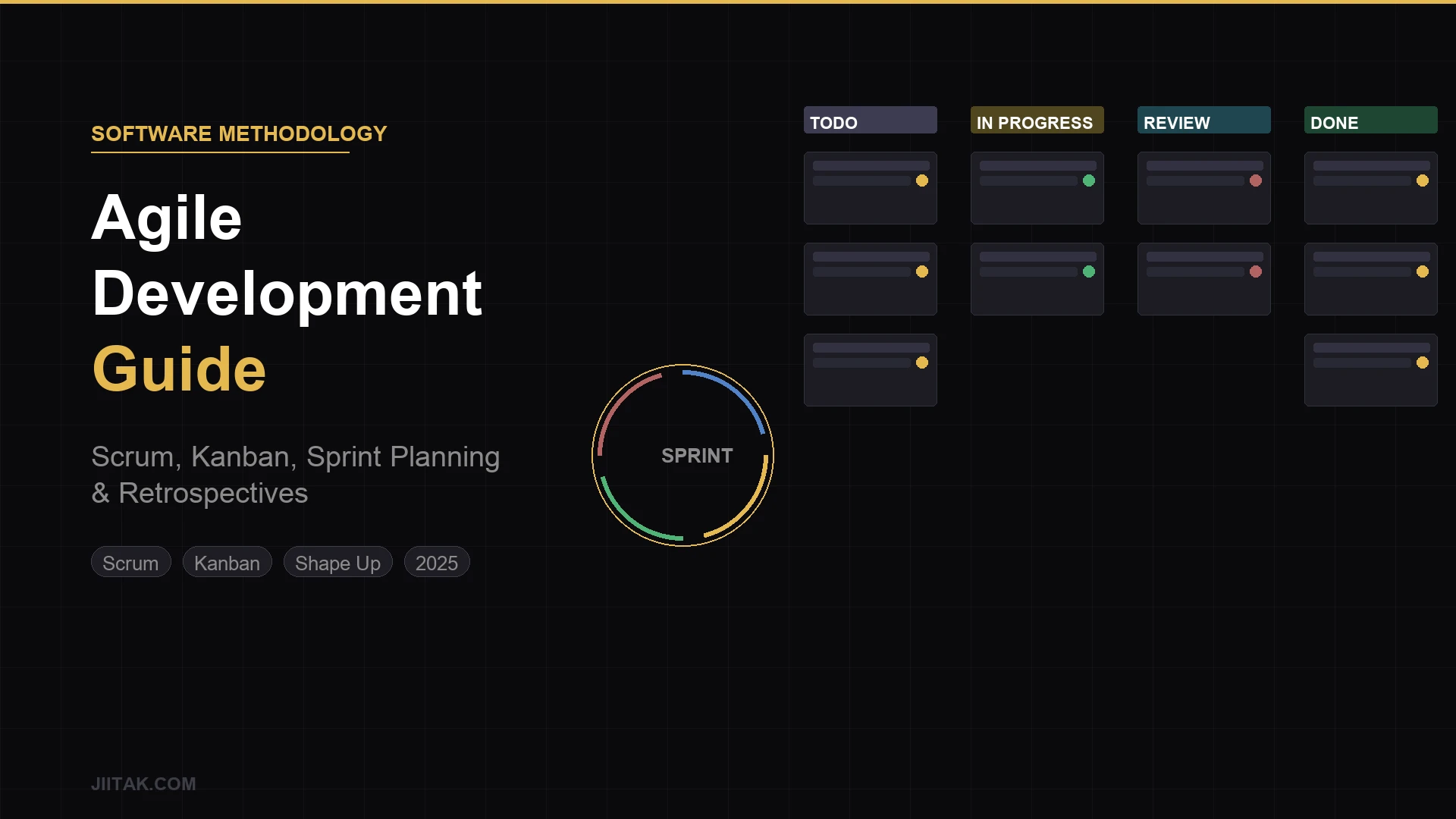
Kanban manages flow rather than iterations. Work moves through defined stages (to-do → in progress → review → done) with WIP (work in progress) limits that prevent bottlenecks from building up invisibly.
Kanban works best when:
- Work is continuous and arrives unpredictably (support, maintenance, ops)
- The goal is reducing cycle time and eliminating bottlenecks
- The team wants to improve flow without restructuring around sprints
Many high-performing product teams run a hybrid: Scrum sprints for feature development, Kanban boards for bugs and support. The key is fitting the system to the work, not the other way around.
Shape Up (Basecamp's Approach)
Shape Up, developed by Basecamp, replaces sprints with 6-week cycles preceded by a "shaping" phase where senior engineers and designers rough out the solution space before committing to build. Teams work without interruption for the full cycle, then have 2 weeks of cool-down for bugs, exploration, and planning.
It's gaining traction in product companies that find Scrum's sprint overhead exhausting and want to give teams more autonomy. The downside: it requires strong senior engineering judgment in the shaping phase and doesn't map well to client-delivery contexts.
Sprint Planning That Actually Works
Most sprint planning sessions fail because they're estimation theater — teams argue over story points for 3 hours and the estimate turns out to be meaningless anyway. Here's what high-velocity teams do instead:
Invest in Story Clarity Before Planning
Backlog refinement (or "grooming") should happen mid-sprint, not at the planning meeting. By the time sprint planning starts, every story in the top 15 should have: clear acceptance criteria, technical approach agreed, dependencies identified, and a size that the team can commit to without debate. If a story can't be discussed in under 5 minutes at planning, it's not ready.
Use Story Points as Relative Sizing, Not Time Estimates
Story points measure complexity and uncertainty relative to a reference story — not hours. Teams that convert story points to days confuse the tool with what it's measuring. Points exist to compare items and identify outlier complexity, not to commit to delivery dates.
Protect the Sprint Commitment
Mid-sprint additions are the most common reason teams miss their sprint goals. The sprint commitment should be treated as a contract with the team — if new priority work arrives urgently, something else comes out, not everything stretches. This is the Product Owner's primary job: protecting the team's focus.
Daily Standups: The Meeting That Usually Wastes 15 Minutes
The daily standup has a specific purpose: synchronize the team, surface blockers, and identify coordination needs. The classic "what I did, what I'll do, any blockers" format is fine when it stays under 15 minutes. It deteriorates when:
- It becomes a status report to management, not a sync for the team
- Problem-solving happens in the standup instead of being taken offline
- Remote-first teams try to sync on video without async alternatives
High-performing remote teams often run async standups (written updates in Slack/Linear) and save video time for planning, review, and retros where real discussion creates value.
Retrospectives: The Most Underused Agile Ceremony
The retrospective is where teams improve — yet it's the ceremony most likely to be skipped when time is tight. That's backwards. Teams that skip retros compound their dysfunction sprint after sprint.
Effective retros share three properties:
- Psychological safety — people say what's actually broken, not what's safe to say
- Concrete action items — "improve communication" is not an action item; "add a technical review step before stories enter sprint" is
- Follow-through accountability — action items from the last retro are reviewed at the start of the next one
Rotate formats to prevent stagnation: Start/Stop/Continue, 4Ls (Liked, Learned, Lacked, Longed For), or Sailboat (wind = helping, anchor = slowing). The format matters less than the conversation it creates.
Measuring Agile Team Health
Velocity (story points per sprint) is the most commonly tracked metric and the most commonly misused. Teams optimize their velocity number — inflating estimates, avoiding uncertain stories, splitting work artificially — rather than actually improving throughput.
Better metrics for team health:
- Cycle time — how long does it take for a story to go from "started" to "done"? Trending down is the goal
- Sprint goal hit rate — what percentage of sprints did the team achieve their stated sprint goal? Below 70% signals systemic planning or scoping problems
- Escaped defects — bugs found in production vs. found in QA. A rising ratio indicates quality debt accumulating
- Deployment frequency — how often does working software reach users? The DORA metrics (deployment frequency, lead time, change failure rate, MTTR) are the industry standard for measuring engineering delivery health
Agile at Scale: What Actually Works
When multiple teams need to coordinate, most organizations reach for SAFe (Scaled Agile Framework) — a heavyweight enterprise framework that often reintroduces the waterfall planning it was meant to replace, just with Agile vocabulary.
Alternatives worth considering:
- Spotify Model — squads, tribes, chapters, and guilds. Widely copied, often poorly implemented. The key insight: autonomous squads aligned to product areas with lightweight coordination mechanisms, not the specific org chart
- LeSS (Large-Scale Scrum) — fewer roles, fewer artifacts, fewer ceremonies than SAFe. Works better for teams that want to scale Scrum without creating a coordination bureaucracy
- Team Topologies — the most practically useful framework for structuring multiple product teams. Focuses on team cognitive load and interaction modes rather than ceremony design
At JIITAK, distributed product teams working across mobile, web, and AI use a pragmatic approach: Scrum sprints for feature delivery, async-first communication, and retrospectives as the primary continuous improvement mechanism. No SAFe. No PI planning. Just working software shipped every two weeks.
Common Agile Anti-Patterns to Avoid
- Agile in name only — daily standups and Jira boards, but waterfall decision-making and no real iteration based on user feedback
- Cargo cult Scrum — following every ceremony without understanding why, leading to overhead without benefit
- Estimation obsession — spending more time debating story point values than improving story clarity
- Skipping discovery — treating Agile as a delivery methodology only, never doing user research or assumption validation before building
- Retrospectives without action — discussing problems every sprint without changing anything
Agile and AI-Assisted Development in 2025
AI coding tools (GitHub Copilot, Cursor, Claude) are changing the economics of sprint delivery. Tasks that took a senior engineer 2 days now take 4 hours. This is compressing cycle times significantly — but also revealing new bottlenecks: code review, QA, and deployment pipelines that haven't kept pace with AI-assisted development speed.
High-performing teams in 2025 are adapting their Agile practices to the new reality: smaller stories sized for AI-assisted completion, more frequent PRs, and QA processes that can review AI-generated code efficiently. The teams that don't adapt will find that AI tools accelerate development without accelerating delivery — the bottleneck just moves.
Getting Started: Practical First Steps
If you're adopting or improving Agile on your team:
- Start with one framework (Scrum or Kanban) and run it properly for 90 days before layering in customizations
- Fix retrospectives first — the compounding benefit of continuous improvement outweighs any other practice change
- Invest in story clarity before sprint planning — the meeting quality is a lagging indicator of backlog quality
- Measure cycle time and deployment frequency, not velocity
- Build in slack — teams running at 100% capacity have zero capacity to improve
If you're building a product and need a team that ships — not just a team that runs sprints — talk to JIITAK. We've delivered 70+ digital products for clients from MVP to scale, and every engagement is built around working software reaching users on a predictable cadence.